Monday, 7 July 2008


Sunday, 14 October 2007
University for Peace announces short courses related to Gender and Peacebuilding
The United Nations affiliated University for Peace in Costa Rica announced that it is offering new short courses related to Gender and Peacebuilding.
Darfur - Peacekeepers Without a Peace to Keep
The New York Times has a short piece entitled, 'Peacekeepers Without a Peace to Keep'.
The article continues the debate on how damaging the attack on AU peacekeepers in Haskanita will be in the short- and mid-term. While this take on the incident isn't new, the author does start to pose some more critical questions about whether military intervention in Darfur is already too late?- Or, is it too early?
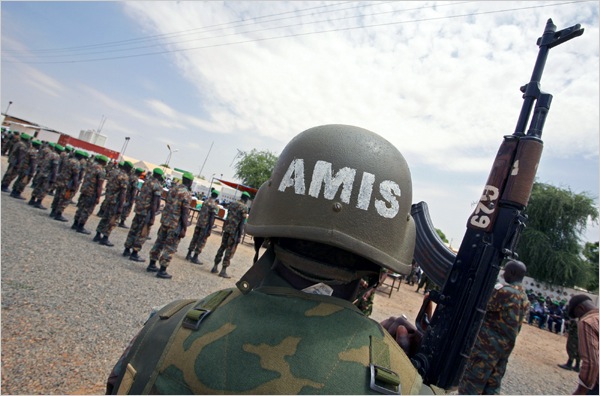
A recent statement by the AU force commander captured the challenge facing peackeepers- 'AU outnumbered, outgunned in Darfur'. It is easy to make calls for peacekeepers to enforce the 'Responsibility to Protect', as Roméo Dallaire does: '...the troops must “go inside the camps, do night patrols and snap inspections, essentially go wherever they need to, without the Sudanese Army or police blocking them.” He said they also need to go after “every one of those splinter groups” and they’ll need the proper gear to do so.' How realistic are these calls?
A number of uncomfortable comparisons in the article are made between Darfur and Somalia. Yet perhaps a better comparison would be the early days of UNPROFOR in the former Yugoslavia? The lack of political will in FRY crippled even relatively well-equipped peackeepers. Can UNAMID hope for better?
The article continues the debate on how damaging the attack on AU peacekeepers in Haskanita will be in the short- and mid-term. While this take on the incident isn't new, the author does start to pose some more critical questions about whether military intervention in Darfur is already too late?- Or, is it too early?
A recent statement by the AU force commander captured the challenge facing peackeepers- 'AU outnumbered, outgunned in Darfur'. It is easy to make calls for peacekeepers to enforce the 'Responsibility to Protect', as Roméo Dallaire does: '...the troops must “go inside the camps, do night patrols and snap inspections, essentially go wherever they need to, without the Sudanese Army or police blocking them.” He said they also need to go after “every one of those splinter groups” and they’ll need the proper gear to do so.' How realistic are these calls?
A number of uncomfortable comparisons in the article are made between Darfur and Somalia. Yet perhaps a better comparison would be the early days of UNPROFOR in the former Yugoslavia? The lack of political will in FRY crippled even relatively well-equipped peackeepers. Can UNAMID hope for better?
Monday, 1 October 2007
Resource- Where does Human Security fit in?
Human Security Review has a great post called 'Human Security 101'.
Great introduction to the competing views of precisely what human security means. While human security is an excellent concept destined to change the way we think about security, at the field level it hasn't really been 'operationalized' by states in their foreign policies, or by IOs in their programs. There should be clear links to the questions of how civilian agencies working in hostile environments view their own security, though this is rarely the case- there is a worrying disconnect between 'their' security, and that of the beneficiaries and their environment. Some of these disconnects were touched upon by the Feinstein Institute's report, 'Mapping the Security Environment: Understanding the perceptions of local communities, peace support operations and assistance agencies'.
'Human security is a relatively new concept and there is much disagreement as to its precise meaning. Below is the definition used by Human Security Review.
Human security looks at security from the level of the individual, as opposed to the state or international system. That is, human security concerns the protection of individuals and societies.
This is not the only definition. Some definitions focus on violent threats to individuals (genocide, conflict, civil war, insurgency…). Human Security Review takes a broader perspective, arguing violence (also called personal security) is only one of many threats to the individual (environmental, health, food, etc…). This broad view of human security is presented in the graphic below.

The horizontal axis represents different types of security while the vertical axis represents levels of analysis. What all definitions of human security agree on, is the level of analysis. The level of analysis is fundamental to human security and separates it from more other perspectives of security. Traditionally security has been viewed from the state level. Many confuse national security and human security, and for good reason. There is much overlap between the concepts and often national security policies are indistinguishable from human security policies. Often, but not always.
Imagine two presidential security advisers in the United States before an imminent nuclear war. One advisor, Mr. Naton, looks at security from the state level (national security). The other advisor, Mr. Hume, looks at security from the individual level (human security). Their different level of analysis matter.
Looking from the national security perspective, Mr. Naton want to secure the entity of the United States. He recommends the core / most important members of the government be placed bunkers. His goal is to protect the government (represented by Congress, the President, and the Supreme Court) and thus the entity of the state survives. That is, he is concerned with threats to the state.
Alternatively looking from the human security perspective, Mr. Hume wants to secure the individuals (who happen to live in the United States). He recommends as many people as possible be placed in bunkers. His goal is to protect the individuals living in the United States. That is, he is concerned with threats to individuals.'
Great introduction to the competing views of precisely what human security means. While human security is an excellent concept destined to change the way we think about security, at the field level it hasn't really been 'operationalized' by states in their foreign policies, or by IOs in their programs. There should be clear links to the questions of how civilian agencies working in hostile environments view their own security, though this is rarely the case- there is a worrying disconnect between 'their' security, and that of the beneficiaries and their environment. Some of these disconnects were touched upon by the Feinstein Institute's report, 'Mapping the Security Environment: Understanding the perceptions of local communities, peace support operations and assistance agencies'.
'Human security is a relatively new concept and there is much disagreement as to its precise meaning. Below is the definition used by Human Security Review.
Human security looks at security from the level of the individual, as opposed to the state or international system. That is, human security concerns the protection of individuals and societies.
This is not the only definition. Some definitions focus on violent threats to individuals (genocide, conflict, civil war, insurgency…). Human Security Review takes a broader perspective, arguing violence (also called personal security) is only one of many threats to the individual (environmental, health, food, etc…). This broad view of human security is presented in the graphic below.

The horizontal axis represents different types of security while the vertical axis represents levels of analysis. What all definitions of human security agree on, is the level of analysis. The level of analysis is fundamental to human security and separates it from more other perspectives of security. Traditionally security has been viewed from the state level. Many confuse national security and human security, and for good reason. There is much overlap between the concepts and often national security policies are indistinguishable from human security policies. Often, but not always.
Imagine two presidential security advisers in the United States before an imminent nuclear war. One advisor, Mr. Naton, looks at security from the state level (national security). The other advisor, Mr. Hume, looks at security from the individual level (human security). Their different level of analysis matter.
Looking from the national security perspective, Mr. Naton want to secure the entity of the United States. He recommends the core / most important members of the government be placed bunkers. His goal is to protect the government (represented by Congress, the President, and the Supreme Court) and thus the entity of the state survives. That is, he is concerned with threats to the state.
Alternatively looking from the human security perspective, Mr. Hume wants to secure the individuals (who happen to live in the United States). He recommends as many people as possible be placed in bunkers. His goal is to protect the individuals living in the United States. That is, he is concerned with threats to individuals.'
UN And African Union Agree to Strengthen Security Cooperation
The UN Security Council and the African Union (AU) issued a joint communiqué where they underlined the importance of developing the African Standby Force, and bolstering their overall collaboration in addressing conflict and building peace. The press statement was the result of a week-long mission by UN Security Council members to Africa. Following their visit to Addis, the members will visit Sudan, Ghana, Côte d’Ivoire and the Democratic Republic of the Congo (DRC).
Are more Afghan civilians killed more by US and NATO forces than by insurgents?
An earlier posting showed the press campaign that NATO was waging to show that it was taking collateral damage as a serious problem- and that they were making alledged improvements in reducing civilian casualties.
Not surprisingly, there is now a full-blown war of statistics being waged in the press- AP calculates that Coalition and NATO forces have killed more civilians than the Taliban insurgents in 2007 (203 vs. 178 deaths). Others say that the numbers are roughly equal.
Will be curious to see the next round of press statements, particularly following a scathing speech by President Karzai on Saturday.
Not surprisingly, there is now a full-blown war of statistics being waged in the press- AP calculates that Coalition and NATO forces have killed more civilians than the Taliban insurgents in 2007 (203 vs. 178 deaths). Others say that the numbers are roughly equal.
Will be curious to see the next round of press statements, particularly following a scathing speech by President Karzai on Saturday.
UN decides to split Department of Peacekeeping Operations
The United Nations General Assembly decided by consensus to split the Department of Peacekeeping Operations (DPKO), creating a new Department of Field Support to look after management and logistic under the supervision of an Under-Secretary-General. The Peacekeeping Department will now concentrate on operations and will also be headed by an Under-Secretary-General.
'...Ban sees it [the splitting of DPKO] as an important part of the reforms process and asserts that it would increase the overall efficiency at a time when the world body is being asked to take on more and more responsibility of peacekeeping.'
'...Ban sees it [the splitting of DPKO] as an important part of the reforms process and asserts that it would increase the overall efficiency at a time when the world body is being asked to take on more and more responsibility of peacekeeping.'
Resource- International Policing Guidelines
A new pubication of interest to readers: 'Peace Support Operations: Information and guidance for UK police personnel'. These guidelines are a resource on specific aspects of policing in PSOs, and include case studies and best practices for users.
'In addition to explaining why the UK makes a contribution to PSOs, the Guidelines outline, among other things, international policing principles, the legal context in which such missions operate, the kinds of tasks UK officers might perform, and the standards of behaviour expected of them. There is nothing similar available either nationally or internationally. The handbook will reinforce officers' pre-deployment training and act as an aide-memoire whilst on mission.'
The UK International Policing website which hosts the document is also an excellent resource.
'In addition to explaining why the UK makes a contribution to PSOs, the Guidelines outline, among other things, international policing principles, the legal context in which such missions operate, the kinds of tasks UK officers might perform, and the standards of behaviour expected of them. There is nothing similar available either nationally or internationally. The handbook will reinforce officers' pre-deployment training and act as an aide-memoire whilst on mission.'
The UK International Policing website which hosts the document is also an excellent resource.
Friday, 14 September 2007
The International Geneva Peacebuilding Guide- An Inventory of Geneva-based capacity and expertise
A new resource was launched this week by the Geneva Centre for Security Policy:
'This conference presents the preliminary findings of an analytical mapping that was undertaken as an integral part of ‘The UN Peacebuilding Commission and International Geneva’ project. Since late 2005, the GCSP and its partners have organised a series of events and public discussions looking at the implications for International Geneva of the work of the UN Peacebuilding Commission. The project has been developed by the Geneva Centre for Security Policy (GCSP) in collaboration with its partners, the Quaker United Nations Office in Geneva (QUNO), the Graduate Institute for International Studies (HEI/PSIS) and the Geneva Centre for Democratic Control of Armed Forces (DCAF). Financial support has been provided by the Swiss Federal Department of Foreign Affairs (FDFA) and the Geneva International Academic Network (GIAN).
Since 2006, the project and its partners have engaged a broad range of International Geneva stakeholders in discussions, workshops and public events, aimed at examining the importance of peacebuilding, and the formation of the UN Peacebuilding Commission (PBC). These events and discussions led to a number of findings and recommendations that looked at how International Geneva could influence peacebuilding issues including questions of financing, local ownership, civil society, expertise, analysis, networks and coordination. Please refer to Annex 3 for more details activities of the project to date.
To complement the ongoing discussions and events of 2006, it was decided to undertake an analytical mapping of the peacebuilding capacities and expertise of Geneva-based stakeholders. The results of this mapping have been made public in an online database, the ‘International Geneva Peacebuilding Guide’. This Guide allows users to conduct complex searches and filtering of the data collected from the mapping. The International Geneva Peacebuidlding Guide can be consulted at the following link: http://www.gcsp.ch/e/publications/IGPeaceProject/Guide/index.htm.
The preliminary findings of the project to date are included in this document, and offer a first glimpse of the data collected as of 09 September 2007. We are able to have a comprehensive look at the topography of the International Geneva peacebuilding landscape, the types of organisations present, the countries in which these organisations are engaged, the peacebuilding sectors in which they are active, and the types of activities they undertake. A total of 69 organisations have provided detailed information on on up to 3 peacebuilding sectors where they feel they have the greatest added value, and have also elaborated on how they engage in these priority sectors in the actual and potential PBC focus countries.'
The Guide can be accessed here.
'This conference presents the preliminary findings of an analytical mapping that was undertaken as an integral part of ‘The UN Peacebuilding Commission and International Geneva’ project. Since late 2005, the GCSP and its partners have organised a series of events and public discussions looking at the implications for International Geneva of the work of the UN Peacebuilding Commission. The project has been developed by the Geneva Centre for Security Policy (GCSP) in collaboration with its partners, the Quaker United Nations Office in Geneva (QUNO), the Graduate Institute for International Studies (HEI/PSIS) and the Geneva Centre for Democratic Control of Armed Forces (DCAF). Financial support has been provided by the Swiss Federal Department of Foreign Affairs (FDFA) and the Geneva International Academic Network (GIAN).
Since 2006, the project and its partners have engaged a broad range of International Geneva stakeholders in discussions, workshops and public events, aimed at examining the importance of peacebuilding, and the formation of the UN Peacebuilding Commission (PBC). These events and discussions led to a number of findings and recommendations that looked at how International Geneva could influence peacebuilding issues including questions of financing, local ownership, civil society, expertise, analysis, networks and coordination. Please refer to Annex 3 for more details activities of the project to date.
To complement the ongoing discussions and events of 2006, it was decided to undertake an analytical mapping of the peacebuilding capacities and expertise of Geneva-based stakeholders. The results of this mapping have been made public in an online database, the ‘International Geneva Peacebuilding Guide’. This Guide allows users to conduct complex searches and filtering of the data collected from the mapping. The International Geneva Peacebuidlding Guide can be consulted at the following link: http://www.gcsp.ch/e/publications/IGPeaceProject/Guide/index.htm.
The preliminary findings of the project to date are included in this document, and offer a first glimpse of the data collected as of 09 September 2007. We are able to have a comprehensive look at the topography of the International Geneva peacebuilding landscape, the types of organisations present, the countries in which these organisations are engaged, the peacebuilding sectors in which they are active, and the types of activities they undertake. A total of 69 organisations have provided detailed information on on up to 3 peacebuilding sectors where they feel they have the greatest added value, and have also elaborated on how they engage in these priority sectors in the actual and potential PBC focus countries.'
The Guide can be accessed here.

Wednesday, 8 August 2007
Save the Date- Geneva Centre for Security Policy Event- 12 September 2007
The Geneva Centre for Security Policy will be hosting a launch event for their project, 'The United Nations Peacebuilding Commission and International Geneva on September 12th, 2007. Further details can be found below.


Wednesday, 1 August 2007
Haiti- UN Peacekeeping Force Evolving to a Policing Role
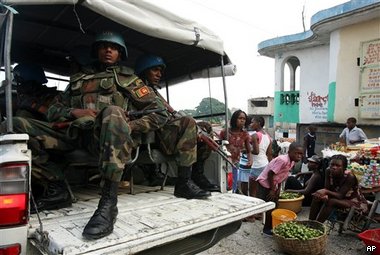
In the lead-up to the UN Secretary General's visit, Haiti is getting some long-merited attention. This AP article takes a balanced look at the challenges facing peacekeeping and peacebuilding in the Haitian state.
Haiti is in a transitional phase, where it is out of immediate crisis, but where, 'The senior U.N. envoy to Haiti says it is too soon for the U.N. to consider withdrawing its 8,800-strong, Brazil-led peacekeeping force, noting past failed attempts to help the country... "An early withdrawal right now would be a big mistake, 'Big' with a capital letter," Edmond Mulet said in a recent interview with The Associated Press. "This is a time to hold on, to make this work this time."'
The challenge is that UN military peacekeepers are obliged to undertake what is essentially a policing function. '... the U.N. mission eventually hopes to use more civilian police than soldiers but is hampered by a world shortage of trained, French-speaking officers... The peacekeepers provide more than 80 percent of Haiti's security needs, but the government is working to eventually take over that responsibility. The national police academy is pumping out hundreds of recruits, trying bolster the nation's small police force of 6,000.'
Chronic poverty and gangs, drug-traffickers still pose a threat to real peace and stability in Haiti, with official suggesting that a UN force will be need until President Preval's term ends in 2011.
Resource- International Policing Guidelines
A new pubication of interest to readers: 'Peace Support Operations: Information and guidance for UK police personnel'. These guidelines are a resource on specific aspects of policing in PSOs, and include case studies and best practices for users.
'In addition to explaining why the UK makes a contribution to PSOs, the Guidelines outline, among other things, international policing principles, the legal context in which such missions operate, the kinds of tasks UK officers might perform, and the standards of behaviour expected of them. There is nothing similar available either nationally or internationally. The handbook will reinforce officers' pre-deployment training and act as an aide-memoire whilst on mission.'
The UK Internatinal Policing website which hosts the document is also an excellent resource.
'In addition to explaining why the UK makes a contribution to PSOs, the Guidelines outline, among other things, international policing principles, the legal context in which such missions operate, the kinds of tasks UK officers might perform, and the standards of behaviour expected of them. There is nothing similar available either nationally or internationally. The handbook will reinforce officers' pre-deployment training and act as an aide-memoire whilst on mission.'
The UK Internatinal Policing website which hosts the document is also an excellent resource.
CMR- Guidelines for Relations Between US Armed Forces and Non-Governmental Humanitarian Organizations
Cross-posted from Civil-Military Relations:
'The United States Institute of Peace launched their Guidelines for Relations Between US Armed Forces and Non-Governmental Humanitarian Organizations on 24 July 2007.
Have pasted in the broad recommendations for armed forces and humanitarian agencies. Taken out of context, it might look a bit simplistic. There's much more in the guidelines, and the processes aspect is particularly well done. One can only guess at how difficult it was in finding 'lowest common denominators' for such a diverse audience. One can quickly find some issues of contention, such as: 'In situations in which there is no actor to servea as a bridge, a US military Civil Affairs cell could serve as a temporary point-of-contact between NGHOs and other elements of the US Armed Forces.' What about OCHA's CMCS?
To be seen how US stakeholders will implement this- and who will enforce it?
'On July 24, 2007, leaders of the U.S. military and NGO community celebrated a promising moment for civil-military relations in peace operations: the rollout of Guidelines that will serve as “rules of the road” for how the two entities operate in hostile environments.
Facilitated by the U.S. Institute of Peace, the Guidelines seek to mitigate frictions between military and NGO personnel over the preservation of humanitarian space in places like Afghanistan and Iraq. Principles in the Guidelines include ensuring that military personnel wear uniforms when conducting relief activities to avoid being mistaken for nongovernmental humanitarian organization representatives. Conversely, it recommends that humanitarian relief personnel avoid traveling in U.S. Armed Forces vehicles with the exception of liaison personnel to the extent practical.
The heads of both the U.S. military and InterAction (an umbrella organization for U.S. NGOs) have endorsed the Guidelines and will be disseminating them throughout their organizations. Two years in the making, the effort represents “a desire from both sides to move beyond polemics to proactive problem solving,” said Jeb Nadaner, Deputy Assistant Secretary of Defense for Stability Operations at the Pentagon. NGO leaders likewise expressed optimism at the potential for change. “We do not want to understate the importance of this document for us,” said Sam Worthington, InterAction President and CEO. “We believe that these guidelines will serve a purpose beyond U.S. NGOs to our global partners.”
The initiative was launched in March 2005 when Amb. Carlos Pascual, Coordinator for Reconstruction and Stabilization at the U.S. State Department, asked the Institute to establish a Working Group on Civil-Military Relations in Non-permissive Environments. What began as a dialogue between military and NGO leaders has resulted in a pioneering effort upon which both sides hope to expand. Military and NGO leaders intend to promulgate the Guidelines throughout their communities via media and education channels: NGOs will publish the Guidelines in their newsletters and literature; the military will incorporate the Guidelines into joint military doctrine publications. The next challenge lies in implementing the Guidelines in the field and creating a monitoring mechanism by which the Guidelines can be continuously tested and revised.
For the U.S. Armed Forces, the following guidelines should be observed consistent with military force protection, mission accomplishment, and operational requirements:
1. When conducting relief activities, military personnel should wear uniforms or other distinctive clothing to avoid being mis taken for NGHO representatives. U.S. Armed Forces personnel and units should not display NGHO logos on any military cloth ing, vehicles, or equipment. This does not preclude the appro priate use of symbols recognized under the law of war, such as a red cross, when appropriate. U.S. Armed Forces may use such symbols on military clothing, vehicles, and equipment in appropriate situations.
2. Visits by U.S. Armed Forces personnel to NGHO sites should be by prior arrangement.
3. U.S. Armed Forces should respect NGHO views on the bearing of arms within NGHO sites.
4. U.S. Armed Forces should give NGHOs the option of meeting with U.S. Armed Forces personnel outside military installations for information exchanges.
5. U.S. Armed Forces should not describe NGHOs as “force mul tipliers” or “partners” of the military, or in any other fashion.
6. U.S. Armed Forces personnel and units should avoid interfer ing with NGHO relief efforts directed toward segments of the civilian population that the military may regard as unfriendly.
7. U.S. Armed Forces personnel and units should respect the de sire of NGHOs not to serve as implementing partners for the military in conducting relief activities. However, individual NGOs may seek to cooperate with the military, in which case such cooperation will be carried out with due regard to avoid ing compromise of the security, safety, and independence of the NGHO community at large, NGHO representatives, or public perceptions of their independence.
For NGHOs, the following guidelines should be observed:
1. NGHO personnel should not wear military-style clothing. This is not meant to preclude NGHO personnel from wearing protec tive gear, such as helmets and protective vests, provided that such items are distinguishable in color/appearance from U.S. Armed Forces issue items.
2. NGHO travel in U.S. Armed Forces vehicles should be limited to liaison personnel to the extent practical.
3. NGHOs should not have facilities co-located with facilities in habited by U.S. Armed Forces personnel.
4. NGHOs should use their own logos on clothing, vehicles, and buildings when security conditions permit.
5. NGHO personnel’s visits to military facilities/sites should be by prior arrangement.
6. Except for liaison arrangements detailed in the sections that follow, NGHOs should minimize their activities at military bases and with U.S. Armed Forces personnel of a nature that might compromise their independence.
7. NGHOs may, as a last resort, request military protection for convoys delivering humanitarian assistance, take advantage of essential logistics support available only from the military, or accept evacuation assistance for medical treatment or to evacuate from a hostile environment. Provision of such mili tary support to NGHOs rests solely within the discretion of the military forces and will not be undertaken if it interferes with higher priority military activities. Support generally will be provided on a reimbursable basis in accordance with appli cable U.S. law.'
'The United States Institute of Peace launched their Guidelines for Relations Between US Armed Forces and Non-Governmental Humanitarian Organizations on 24 July 2007.
Have pasted in the broad recommendations for armed forces and humanitarian agencies. Taken out of context, it might look a bit simplistic. There's much more in the guidelines, and the processes aspect is particularly well done. One can only guess at how difficult it was in finding 'lowest common denominators' for such a diverse audience. One can quickly find some issues of contention, such as: 'In situations in which there is no actor to servea as a bridge, a US military Civil Affairs cell could serve as a temporary point-of-contact between NGHOs and other elements of the US Armed Forces.' What about OCHA's CMCS?
To be seen how US stakeholders will implement this- and who will enforce it?
'On July 24, 2007, leaders of the U.S. military and NGO community celebrated a promising moment for civil-military relations in peace operations: the rollout of Guidelines that will serve as “rules of the road” for how the two entities operate in hostile environments.
Facilitated by the U.S. Institute of Peace, the Guidelines seek to mitigate frictions between military and NGO personnel over the preservation of humanitarian space in places like Afghanistan and Iraq. Principles in the Guidelines include ensuring that military personnel wear uniforms when conducting relief activities to avoid being mistaken for nongovernmental humanitarian organization representatives. Conversely, it recommends that humanitarian relief personnel avoid traveling in U.S. Armed Forces vehicles with the exception of liaison personnel to the extent practical.
The heads of both the U.S. military and InterAction (an umbrella organization for U.S. NGOs) have endorsed the Guidelines and will be disseminating them throughout their organizations. Two years in the making, the effort represents “a desire from both sides to move beyond polemics to proactive problem solving,” said Jeb Nadaner, Deputy Assistant Secretary of Defense for Stability Operations at the Pentagon. NGO leaders likewise expressed optimism at the potential for change. “We do not want to understate the importance of this document for us,” said Sam Worthington, InterAction President and CEO. “We believe that these guidelines will serve a purpose beyond U.S. NGOs to our global partners.”
The initiative was launched in March 2005 when Amb. Carlos Pascual, Coordinator for Reconstruction and Stabilization at the U.S. State Department, asked the Institute to establish a Working Group on Civil-Military Relations in Non-permissive Environments. What began as a dialogue between military and NGO leaders has resulted in a pioneering effort upon which both sides hope to expand. Military and NGO leaders intend to promulgate the Guidelines throughout their communities via media and education channels: NGOs will publish the Guidelines in their newsletters and literature; the military will incorporate the Guidelines into joint military doctrine publications. The next challenge lies in implementing the Guidelines in the field and creating a monitoring mechanism by which the Guidelines can be continuously tested and revised.
For the U.S. Armed Forces, the following guidelines should be observed consistent with military force protection, mission accomplishment, and operational requirements:
1. When conducting relief activities, military personnel should wear uniforms or other distinctive clothing to avoid being mis taken for NGHO representatives. U.S. Armed Forces personnel and units should not display NGHO logos on any military cloth ing, vehicles, or equipment. This does not preclude the appro priate use of symbols recognized under the law of war, such as a red cross, when appropriate. U.S. Armed Forces may use such symbols on military clothing, vehicles, and equipment in appropriate situations.
2. Visits by U.S. Armed Forces personnel to NGHO sites should be by prior arrangement.
3. U.S. Armed Forces should respect NGHO views on the bearing of arms within NGHO sites.
4. U.S. Armed Forces should give NGHOs the option of meeting with U.S. Armed Forces personnel outside military installations for information exchanges.
5. U.S. Armed Forces should not describe NGHOs as “force mul tipliers” or “partners” of the military, or in any other fashion.
6. U.S. Armed Forces personnel and units should avoid interfer ing with NGHO relief efforts directed toward segments of the civilian population that the military may regard as unfriendly.
7. U.S. Armed Forces personnel and units should respect the de sire of NGHOs not to serve as implementing partners for the military in conducting relief activities. However, individual NGOs may seek to cooperate with the military, in which case such cooperation will be carried out with due regard to avoid ing compromise of the security, safety, and independence of the NGHO community at large, NGHO representatives, or public perceptions of their independence.
For NGHOs, the following guidelines should be observed:
1. NGHO personnel should not wear military-style clothing. This is not meant to preclude NGHO personnel from wearing protec tive gear, such as helmets and protective vests, provided that such items are distinguishable in color/appearance from U.S. Armed Forces issue items.
2. NGHO travel in U.S. Armed Forces vehicles should be limited to liaison personnel to the extent practical.
3. NGHOs should not have facilities co-located with facilities in habited by U.S. Armed Forces personnel.
4. NGHOs should use their own logos on clothing, vehicles, and buildings when security conditions permit.
5. NGHO personnel’s visits to military facilities/sites should be by prior arrangement.
6. Except for liaison arrangements detailed in the sections that follow, NGHOs should minimize their activities at military bases and with U.S. Armed Forces personnel of a nature that might compromise their independence.
7. NGHOs may, as a last resort, request military protection for convoys delivering humanitarian assistance, take advantage of essential logistics support available only from the military, or accept evacuation assistance for medical treatment or to evacuate from a hostile environment. Provision of such mili tary support to NGHOs rests solely within the discretion of the military forces and will not be undertaken if it interferes with higher priority military activities. Support generally will be provided on a reimbursable basis in accordance with appli cable U.S. law.'
Sudan- Aid convoys under attack in Darfur
Two articles chronicling a 'dramatic rise in attacks on aid convoys in Darfur', according to the World Food Programme. The impact was measured by the number of people now 'out of reach' for food aid, apparently now at 170,000.
Nothing earth shattering in the piece, beyond the scale of challenges facing civilian actors in a context where the range of arms carriers continues to multiply as groups fracture into smaller and smaller entities, with little link to any clear chain of command. Perhaps it's a poor measure of insecurity, but given the sheer scale of the operation, couldn't we consider the insecurity to be statistically lower than in a comparatively smaller operation? A good overview of WFP assets and exposure are including in the original WFP text:
'The WFP’s food distribution in Darfur is the largest ongoing humanitarian effort in the world, employing nearly 800 people and over 700 trucks to feed more than two million people every month. The U.N. agency says it plans to distribute up to 450,000 metric tons of food in Darfur at a cost of about half a billion dollars this year.
The UN’s Office for Coordination of Humanitarian Affairs said in an email to The Associated Press that 76 vehicles from the U.N. or other aid groups have been stolen in Darfur so far this year, and that 77 humanitarian convoys were attacked. The WFP said 18 of its food convoys have been attacked this year, and 10 staff, including contractors, have been either detained or abducted. The attacks are carried out by several of Darfur’s various warring parties, and the WFP believes the motive is banditry, said Emilia Casella, the WFP spokeswoman in Sudan. “The people who are doing this are wearing different kinds of uniforms,” she said, calling on “all parties in Darfur” to cease attacks and respect humanitarian workers. Large amounts of food have also been looted during ambushes, Casella said. There were five attacks last week in southern Darfur, she said, and gunmen looted seven trucks, stealing approximately 10 metric tons of food.'
Nothing earth shattering in the piece, beyond the scale of challenges facing civilian actors in a context where the range of arms carriers continues to multiply as groups fracture into smaller and smaller entities, with little link to any clear chain of command. Perhaps it's a poor measure of insecurity, but given the sheer scale of the operation, couldn't we consider the insecurity to be statistically lower than in a comparatively smaller operation? A good overview of WFP assets and exposure are including in the original WFP text:
'The WFP’s food distribution in Darfur is the largest ongoing humanitarian effort in the world, employing nearly 800 people and over 700 trucks to feed more than two million people every month. The U.N. agency says it plans to distribute up to 450,000 metric tons of food in Darfur at a cost of about half a billion dollars this year.
The UN’s Office for Coordination of Humanitarian Affairs said in an email to The Associated Press that 76 vehicles from the U.N. or other aid groups have been stolen in Darfur so far this year, and that 77 humanitarian convoys were attacked. The WFP said 18 of its food convoys have been attacked this year, and 10 staff, including contractors, have been either detained or abducted. The attacks are carried out by several of Darfur’s various warring parties, and the WFP believes the motive is banditry, said Emilia Casella, the WFP spokeswoman in Sudan. “The people who are doing this are wearing different kinds of uniforms,” she said, calling on “all parties in Darfur” to cease attacks and respect humanitarian workers. Large amounts of food have also been looted during ambushes, Casella said. There were five attacks last week in southern Darfur, she said, and gunmen looted seven trucks, stealing approximately 10 metric tons of food.'
Resource- Where does Human Security fit in?
Human Security Review has a great post called 'Human Security 101'.
Great introduction to the competing views of precisely what human security means. While human security is an excellent concept destined to change the way we think about security, at the field level it hasn't really been 'operationalized' by states in their foreign policies, or by IOs in their programs. There should be clear links to the questions of how civilian agencies working in hostile environments view their own security, though this is rarely the case- there is a worrying disconnect between 'their' security, and that of the beneficiaries and their environment. Some of these disconnects were touched upon by the Feinstein Institute's report, 'Mapping the Security Environment: Understanding the perceptions of local communities, peace support operations and assistance agencies'.
'Human security is a relatively new concept and there is much disagreement as to its precise meaning. Below is the definition used by Human Security Review.
Human security looks at security from the level of the individual, as opposed to the state or international system. That is, human security concerns the protection of individuals and societies.
This is not the only definition. Some definitions focus on violent threats to individuals (genocide, conflict, civil war, insurgency…). Human Security Review takes a broader perspective, arguing violence (also called personal security) is only one of many threats to the individual (environmental, health, food, etc…). This broad view of human security is presented in the graphic below.
The horizontal axis represents different types of security while the vertical axis represents levels of analysis. What all definitions of human security agree on, is the level of analysis. The level of analysis is fundamental to human security and separates it from more other perspectives of security. Traditionally security has been viewed from the state level. Many confuse national security and human security, and for good reason. There is much overlap between the concepts and often national security policies are indistinguishable from human security policies. Often, but not always.
Imagine two presidential security advisers in the United States before an imminent nuclear war. One advisor, Mr. Naton, looks at security from the state level (national security). The other advisor, Mr. Hume, looks at security from the individual level (human security). Their different level of analysis matter.
Looking from the national security perspective, Mr. Naton want to secure the entity of the United States. He recommends the core / most important members of the government be placed bunkers. His goal is to protect the government (represented by Congress, the President, and the Supreme Court) and thus the entity of the state survives. That is, he is concerned with threats to the state.
Alternatively looking from the human security perspective, Mr. Hume wants to secure the individuals (who happen to live in the United States). He recommends as many people as possible be placed in bunkers. His goal is to protect the individuals living in the United States. That is, he is concerned with threats to individuals.'
Great introduction to the competing views of precisely what human security means. While human security is an excellent concept destined to change the way we think about security, at the field level it hasn't really been 'operationalized' by states in their foreign policies, or by IOs in their programs. There should be clear links to the questions of how civilian agencies working in hostile environments view their own security, though this is rarely the case- there is a worrying disconnect between 'their' security, and that of the beneficiaries and their environment. Some of these disconnects were touched upon by the Feinstein Institute's report, 'Mapping the Security Environment: Understanding the perceptions of local communities, peace support operations and assistance agencies'.
'Human security is a relatively new concept and there is much disagreement as to its precise meaning. Below is the definition used by Human Security Review.
Human security looks at security from the level of the individual, as opposed to the state or international system. That is, human security concerns the protection of individuals and societies.
This is not the only definition. Some definitions focus on violent threats to individuals (genocide, conflict, civil war, insurgency…). Human Security Review takes a broader perspective, arguing violence (also called personal security) is only one of many threats to the individual (environmental, health, food, etc…). This broad view of human security is presented in the graphic below.
The horizontal axis represents different types of security while the vertical axis represents levels of analysis. What all definitions of human security agree on, is the level of analysis. The level of analysis is fundamental to human security and separates it from more other perspectives of security. Traditionally security has been viewed from the state level. Many confuse national security and human security, and for good reason. There is much overlap between the concepts and often national security policies are indistinguishable from human security policies. Often, but not always.
Imagine two presidential security advisers in the United States before an imminent nuclear war. One advisor, Mr. Naton, looks at security from the state level (national security). The other advisor, Mr. Hume, looks at security from the individual level (human security). Their different level of analysis matter.
Looking from the national security perspective, Mr. Naton want to secure the entity of the United States. He recommends the core / most important members of the government be placed bunkers. His goal is to protect the government (represented by Congress, the President, and the Supreme Court) and thus the entity of the state survives. That is, he is concerned with threats to the state.
Alternatively looking from the human security perspective, Mr. Hume wants to secure the individuals (who happen to live in the United States). He recommends as many people as possible be placed in bunkers. His goal is to protect the individuals living in the United States. That is, he is concerned with threats to individuals.'
Lebanon- Peacekeeping with Hizballah's Help | TIME
TIME has an excellent piece on the challenges facing the relatively successful UNIFIL mission in Lebanon. The peacekeepers are apparently being forced to 'shake hands with the devil'- in order to improve their force protection, and reduce further threats from yet another metaphoric devil. The suggestion is that UNIFIL is obliged to maintain contacts with Hizbollah, in order to protect themselves from further Al-Qaeda attacks:
'The contingents comprising the peacekeeping force known as UNIFIL have good cause for concern. Last month, six Spanish and Colombian UNIFIL soldiers were killed in a bomb ambush, the deadliest attack against the peacekeeping mission in its 29-year history. In a video message released this week, Al-Qaeda deputy leader Ayman al-Zawahiri hailed the attack as "a response against those invading Crusader forces who were occupying a beloved part of the land of Islam". And, UNIFIL officials fear, given the worsening security situation in Lebanon, there could be more attacks on the way. "The major difficulty we are going to face for sure is this kind of terrorist attack because even if we have no idea yet who could be the perpetrators... another attack can come," Major General Claudio Graziano, UNIFIL's commander, told TIME in an interview at his headquarters in the southern coastal village of Naqoura.'
Whatever contacts may exist between UNIFIL and Hizbollah, there was also another roadside bomb that struck a peacekeeping vehicle, the second such incident in a month.
'The contingents comprising the peacekeeping force known as UNIFIL have good cause for concern. Last month, six Spanish and Colombian UNIFIL soldiers were killed in a bomb ambush, the deadliest attack against the peacekeeping mission in its 29-year history. In a video message released this week, Al-Qaeda deputy leader Ayman al-Zawahiri hailed the attack as "a response against those invading Crusader forces who were occupying a beloved part of the land of Islam". And, UNIFIL officials fear, given the worsening security situation in Lebanon, there could be more attacks on the way. "The major difficulty we are going to face for sure is this kind of terrorist attack because even if we have no idea yet who could be the perpetrators... another attack can come," Major General Claudio Graziano, UNIFIL's commander, told TIME in an interview at his headquarters in the southern coastal village of Naqoura.'
Whatever contacts may exist between UNIFIL and Hizbollah, there was also another roadside bomb that struck a peacekeeping vehicle, the second such incident in a month.
UN Investigations of various abuses by peacekeeping troops
The United Nations is investigating allegations of widespread sexual abuse and exploitation by peacekeepers serving in Ivory Coast. A UN statement said the latest allegations had been uncovered by an internal inquiry, and a full investigation was now under way.
While the accused contingent has not been named publicly, apparently the entire unit has been confined to base while the investigation continues.
In 2007 alone, there have been investigations into sexual abuse claims in the Sudan, Liberia, Haiti and Ivory Coast, and reports that sexual abuse allegations have doubled over 2006.
This new investigation follows on the heels of an ongoing probe of Indian peacekeepers stationed in eastern DRC, who allegedly were trafficking in gold and guns. The accusations suggested that the Indians were trading food rations for gold with Rwandan rebels.
Update: AlertNet stated the nationality of the suspended peacekeeping troops in Ivory Coast is Moroccan.
While the accused contingent has not been named publicly, apparently the entire unit has been confined to base while the investigation continues.
In 2007 alone, there have been investigations into sexual abuse claims in the Sudan, Liberia, Haiti and Ivory Coast, and reports that sexual abuse allegations have doubled over 2006.
This new investigation follows on the heels of an ongoing probe of Indian peacekeepers stationed in eastern DRC, who allegedly were trafficking in gold and guns. The accusations suggested that the Indians were trading food rations for gold with Rwandan rebels.
Update: AlertNet stated the nationality of the suspended peacekeeping troops in Ivory Coast is Moroccan.
Tuesday, 31 July 2007
Sierra Leone: UN, partners voice 'utmost concern' at electoral violence Scoop: Sierra Leone: UN & Partners Voice Utmost Concern
Some worrying news from Sierra Leone:
'The United Nations and its international partners have voiced renewed concern at widely reported cases of intimidation and violence ahead of elections in Sierra Leone next month, calling on all concerned to avoid incitement and provocation in the small West African country that is still recovering from a disastrous decade-long civil war.
"The UN and international community remain fully committed to supporting credible, fair and violence-free elections," the partners said in a weekend statement, which welcomed positive steps by the Government, including a successful voter registration exercise and preparations for polling, counting, tallying and the announcement of results.
"However, since the official start of campaigning, cases of intimidation and violence have been widely reported. We view this development with utmost concern. It constitutes a threat to the democratic process. It also goes against the interests of the people of Sierra Leone, who want peaceful, free and credible elections," they added.
The statement called upon leaders of all political parties to promote a peaceful campaign and prevent provocative conduct on the part of their supporters as the country prepares to vote in presidential and parliamentary elections on 11 August, the second since emerging from the civil war in 2002.'
'The United Nations and its international partners have voiced renewed concern at widely reported cases of intimidation and violence ahead of elections in Sierra Leone next month, calling on all concerned to avoid incitement and provocation in the small West African country that is still recovering from a disastrous decade-long civil war.
"The UN and international community remain fully committed to supporting credible, fair and violence-free elections," the partners said in a weekend statement, which welcomed positive steps by the Government, including a successful voter registration exercise and preparations for polling, counting, tallying and the announcement of results.
"However, since the official start of campaigning, cases of intimidation and violence have been widely reported. We view this development with utmost concern. It constitutes a threat to the democratic process. It also goes against the interests of the people of Sierra Leone, who want peaceful, free and credible elections," they added.
The statement called upon leaders of all political parties to promote a peaceful campaign and prevent provocative conduct on the part of their supporters as the country prepares to vote in presidential and parliamentary elections on 11 August, the second since emerging from the civil war in 2002.'
Friday, 27 July 2007
Launch of the ICT for peace foundation, Geneva
We are happy to see the following announcement:
'The ICT4Peace Foundation announced the launch of ICT4Peace: An International Process for Crisis Management today.
ICT4Peace aims to enhance the performance of the international community in crisis management through the application of information Communications Technology (ICT) - technologies that can facilitate effective and sustained communication between peoples, communities and stakeholders involved in crisis management, humanitarian aid and peacebuilding. Crisis management is defined, for the purposes of this process, as civilian and/or military intervention in a crisis that may be a violent or non-violent with the intention of preventing a further escalation of the crisis and facilitating its resolution. This definition covers peace mediation, peace-keeping and peace-building activities of the international community. In bridging the fragmentation between various organisations and activities during different crisis phases, ICT4Peace aims to facilitate a holistic, cohesive and collaborative mechanisms directly in line with Paragraph 36 of the WSIS Tunis Commitment.'
A comprehensive concept note on the project can be found here. They also have their own blog.
'The ICT4Peace Foundation announced the launch of ICT4Peace: An International Process for Crisis Management today.
ICT4Peace aims to enhance the performance of the international community in crisis management through the application of information Communications Technology (ICT) - technologies that can facilitate effective and sustained communication between peoples, communities and stakeholders involved in crisis management, humanitarian aid and peacebuilding. Crisis management is defined, for the purposes of this process, as civilian and/or military intervention in a crisis that may be a violent or non-violent with the intention of preventing a further escalation of the crisis and facilitating its resolution. This definition covers peace mediation, peace-keeping and peace-building activities of the international community. In bridging the fragmentation between various organisations and activities during different crisis phases, ICT4Peace aims to facilitate a holistic, cohesive and collaborative mechanisms directly in line with Paragraph 36 of the WSIS Tunis Commitment.'
A comprehensive concept note on the project can be found here. They also have their own blog.
The New Security Beat: PODCAST - Trade, Aid and Security
The New Security Beat has an interesting podcast on Trade, Aid and Security: An agenda for peace and development. From their post:
'Current approaches to trade and aid often fail to stem poverty, promote stability, or prevent conflict in the developing world. According to Trade, Aid and Security: An agenda for peace and development, existing policies are poorly designed and benefit rich countries, denying developing nations access to vital financial markets. Lifting people out of poverty requires a secure environment and effective trade and aid policies can promote the preconditions for peace and stability. Oli Brown, Project Manager and Policy Researcher at the International Institute for Sustainable Development and one of the editors of Trade, Aid and Security, discusses current development strategies and the conditions for wider political and economic stability.'

'Current approaches to trade and aid often fail to stem poverty, promote stability, or prevent conflict in the developing world. According to Trade, Aid and Security: An agenda for peace and development, existing policies are poorly designed and benefit rich countries, denying developing nations access to vital financial markets. Lifting people out of poverty requires a secure environment and effective trade and aid policies can promote the preconditions for peace and stability. Oli Brown, Project Manager and Policy Researcher at the International Institute for Sustainable Development and one of the editors of Trade, Aid and Security, discusses current development strategies and the conditions for wider political and economic stability.'
Subscribe to:
Posts (Atom)


